On March 26, 1978, 31-year-old Mary Jane Hill was found dead along Highway 16 east of Prince Rupert, British Columbia. She was a Nisga’a woman and a mother of three. Her death occurred decades before the stretch of highway would become nationally known as the Highway of Tears, but her story would eventually become part of the painful history surrounding Indigenous women who disappeared or were found dead along northern British Columbia’s highways.
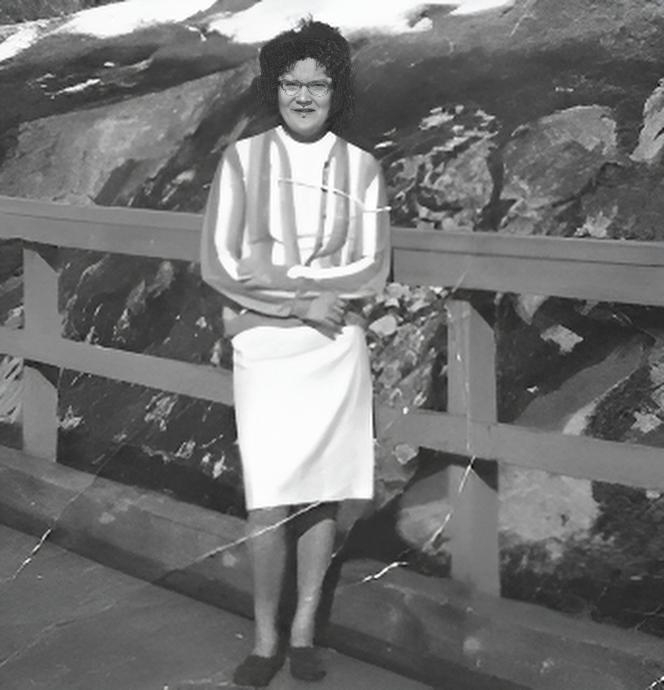
Mary Jane’s body was discovered approximately 21 miles, or 34 kilometres, east of the Prince Rupert city centre. She had been found without clothing, far from the city where she had been living. From the beginning, there were circumstances that suggested this was not simply the death of a woman who had become ill and died on her own.
Police appealed to motorists who had travelled Highway 16 between Tyee and Prince Rupert around the time Mary Jane was found. Investigators wanted to know whether anyone had seen her, encountered her along the highway or noticed anything unusual in the area.
What investigators learned only raised more questions.
Mary Jane’s clothing was not found with her. According to testimony later given by her daughter, Vicki at the National Inquiry into Missing and Murdered Indigenous Women and Girls, her mother’s clothing was discovered in an alley back in Prince Rupert – approximately 33 kilometres from where Mary Jane’s body was found. Medication Mary Jane took for epilepsy was also reportedly found with her clothing.
There was also biological evidence that made the circumstances even more concerning. Semen was reportedly found on Mary Jane’s body.
The presence of semen by itself would not establish that Mary Jane was sexually assaulted, however when considered alongside the fact that Mary Jane was found without clothing more than 30 kilometres outside Prince Rupert while her clothes remained behind in an alley in the city, it raised serious questions about what had happened during the final hours of her life.
There was apparently another potential lead. During her 2017 testimony, Vicki recalled police mentioning an older white car in connection with the investigation. Publicly available information does not establish who was driving that vehicle, what connection it had to Mary Jane or whether investigators were ever able to determine its significance.
Then came one of the most difficult aspects of Mary Jane’s case to understand.
Her medical cause of death was determined to be bronchitis and bronchopneumonia. Taken by itself, that would suggest that her death appeared to have been the result of a natural illness.
But that wasn’t the complete finding.
A coroner’s jury considered the circumstances surrounding Mary Jane’s death and concluded that she had died on or about March 26, 1978, along Highway 16. After identifying bronchitis and bronchopneumonia as the medical cause of death, the jury made another finding: Mary Jane Hill’s death was the result of manslaughter.
That distinction is enormously important.
A medical cause of death describes the physical process that resulted in someone’s death. It does not necessarily explain how that person came to be in the circumstances that caused the fatal condition. Someone can ultimately die from illness, exposure or another medical complication while another person’s actions or potentially their failure to provide necessary assistance contributed to creating the circumstances that caused the death.
Exactly what the coroner’s jury believed happened to Mary Jane is not clear from the surviving public record. But its conclusion that her death resulted from manslaughter indicates that the jury did not regard her death as simply an uncomplicated natural death.
Yet no one was ever charged.
As the years passed, another troubling contradiction emerged. When the RCMP eventually established Project E-PANA to examine a group of unsolved murders and disappearances associated with highways in northern British Columbia, Mary Jane’s case was not included.
According to later research into the Highway of Tears cases, the RCMP’s position was that Mary Jane’s autopsy had leaned more toward natural causes. At the same time, it was acknowledged that investigators had never determined how she came to be at the location where her body was discovered.
For Mary Jane’s family, that left an extraordinary question unanswered. How could her death effectively be treated as leaning toward natural causes when a coroner’s jury had specifically determined that it resulted from manslaughter?
And there were the physical circumstances that still needed explaining.
Mary Jane had somehow travelled or been transported more than 30 kilometres outside Prince Rupert. She was found without clothing. Her clothes were reportedly discovered back in Prince Rupert. Semen was reportedly present on her body. A coroner’s jury determined that her death resulted from manslaughter.
Someone must have known how Mary Jane reached that stretch of highway.
Someone must have been with her before she died.
Mary Jane’s daughter Vicki was only six months old when her mother died. She grew up with no memories of Mary Jane and with questions that would follow her into adulthood. Eventually, she began trying to piece together her mother’s final hours through police documents, newspaper reports, coroner’s records and whatever other information she could obtain.
In September 2017, Vicki brought her mother’s story before the National Inquiry into Missing and Murdered Indigenous Women and Girls during hearings in Smithers, British Columbia.
There, she spoke publicly about Mary Jane and the unanswered questions surrounding her death. She presented records relating to the case and read from the coroner’s findings. She also spoke about the discovery of her mother’s clothing and the evidence found on her body.
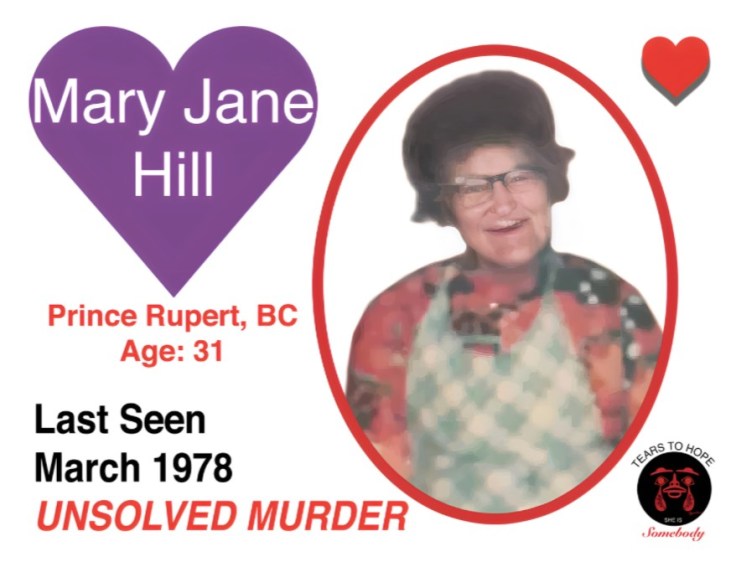
For Vicki, there was another painful issue: she wanted her mother recognized among the women associated with the Highway of Tears.
Mary Jane died along Highway 16 years before the phrase “Highway of Tears” became widely known. Over the following decades, numerous women and girls – disproportionately Indigenous – would disappear or be murdered along highways running through northern British Columbia.
Mary Jane’s name is now included by organizations such as the Tears to Hope Society, which describes her case as an unsolved murder. But she was not included among the official cases investigated through Project E-PANA.
Nearly five decades later, there is still no publicly established account of what happened during Mary Jane’s final hours.
Who was she with before she died? How did she get from Prince Rupert to a location approximately 34 kilometres outside the city? Why were her clothes left behind in an alley? Who was responsible for the semen found on her body, and were investigators ever able to identify that person? What was the significance, if any, of the older white vehicle reportedly mentioned during the investigation? And most importantly, what evidence caused a coroner’s jury to conclude that Mary Jane’s death resulted from manslaughter?
Those questions remain unanswered.
It is also important not to go beyond what the evidence establishes. The available information does not prove that Mary Jane was sexually assaulted, nor does it publicly identify the person or people responsible for placing her in the circumstances that led to her death.
Note: It is my belief that Mary Jane Hill was sexually assaulted and left for dead – naked – on the side of Highway 16. There is no reason that Mary Jane Hill should not be considered as a victim of the Highway of Tears.
What it does establish is troubling enough.
A 31-year-old mother was found without clothing beside Highway 16, more than 30 kilometres outside Prince Rupert. Her clothing was reportedly discovered back in the city. Semen was reportedly found on her body. Her medical cause of death was recorded as bronchitis and bronchopneumonia, but a coroner’s jury went further and determined that her death was the result of manslaughter.
No one has ever been charged.
Mary Jane Hill’s family has lived with that contradiction – and those unanswered questions – since 1978. Her daughter was only an infant when she lost her mother. Decades later, Vicki was still fighting simply to understand what happened to her.
Mary Jane’s story is therefore about more than an unusual cause-of-death finding. It is about everything surrounding that finding that was never adequately explained.
Someone knew how Mary Jane Hill ended up beside Highway 16 on March 26, 1978.
After all these years, her family is still waiting for that story to be told.
If you have any information regarding the death of Mary Jane Hill, please contact:
Prince Rupert Police Service: 250-624-2136
Crime Stoppers: 1-800-222-TIPS(8477)
Online at: https://www.canadiancrimestoppers.org/submit…/submit-a-tip
Crime Stoppers provides anonymous tipping
Sources: National Inquiry into Missing and Murdered Indigenous Women and Girls – Smithers Community Hearings and testimony of Vicki Hill, Tears to Hope Society, An Awkward Silence by Maryanne Pearce, The Canadian Press, historical reporting concerning the investigation into Mary Jane Hill’s death, and Highway of Tears archival material.
🕯️ Subscribe to Someone Saw Something. I dig through the details, ask the unanswered questions, and occasionally fall down research rabbit holes so you don’t have to. 🧡

