Emanuela Orlandi’s disappearance is one of Italy’s most famous mysteries, but beneath the decades of conspiracy theories is a relatively simple and deeply unsettling missing-person case. A 15-year-old girl left her music school in central Rome on June 22, 1983, and never made it home. More than 43 years later, what happened to her remains unknown.
Emanuela was born on January 14, 1968, and lived with her family inside Vatican City. Her father, Ercole Orlandi, worked for the Vatican, which meant Emanuela was a Vatican citizen even though much of her everyday life took place across the border in Rome. She was one of five children and had a strong interest in music, particularly playing the flute.
On Wednesday, June 22, 1983, Emanuela left her family’s Vatican apartment at around 4:00pm to attend a music lesson at the Tommaso Ludovico da Victoria music school in the Sant’Apollinare complex, near Piazza Navona. It was an extremely hot afternoon, and Emanuela reportedly asked her older brother Pietro if he could drive her. He was unable to, so she travelled to the lesson on her own.

Something unusual apparently happened either before or around the time of that lesson.
Emanuela later telephoned home and spoke with her sister Federica. She told her about a man who had approached her with what sounded like a promotional job opportunity involving Avon cosmetics. According to accounts of the conversation, Emanuela had been offered an unusually large amount of money to distribute promotional material at a fashion event.
Federica was suspicious of the offer and advised Emanuela not to agree to anything before discussing it with their parents. After her lesson, Emanuela reportedly mentioned the strange offer to classmates as well.
She then walked toward a bus stop on Corso Rinascimento, near Palazzo Madama, the home of the Italian Senate. Accounts place her in this area at approximately 7:30pm. There were reports that she was seen talking with another girl, although the exact circumstances surrounding this sighting have remained uncertain.
After that, Emanuela disappeared. She did not return to Vatican City.
When enough time passed for her family to realize something was wrong, they began searching for her themselves. They contacted people associated with the music school and searched the route Emanuela normally travelled.
Her father also approached police that night. According to the family’s account, the initial response suggested that Emanuela might simply be out with friends and that the family should wait.
By the following morning, however, it was clear that something much more serious might have happened.
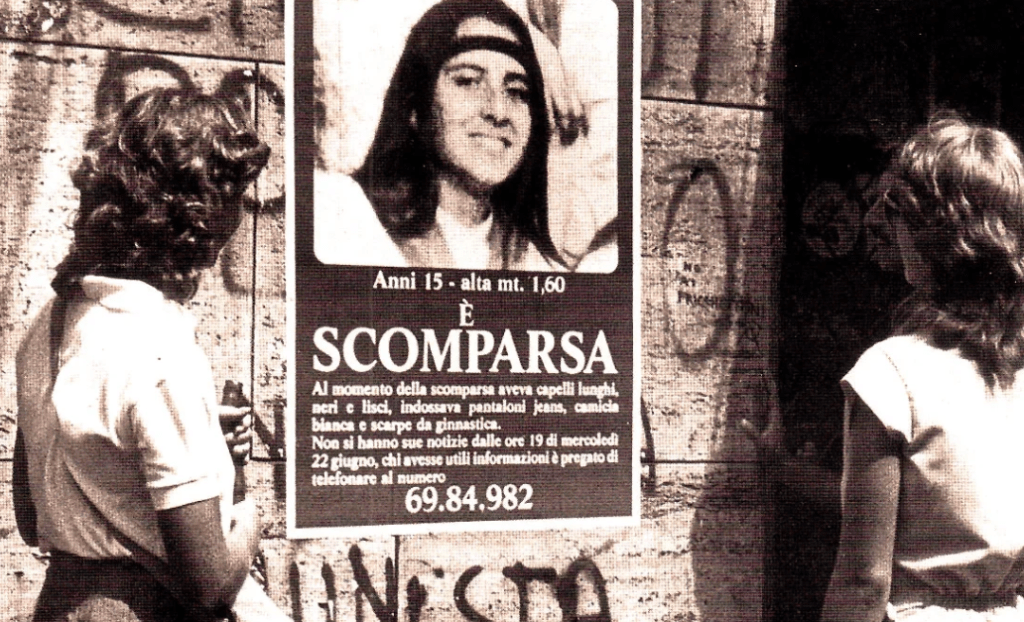
The Orlandi family began distributing photographs of Emanuela throughout Rome. Thousands of missing-person posters appeared around the city.
Then the telephone calls began.
Several people claimed to have seen Emanuela. One early caller identified himself as a teenager named “Pierluigi” and described encountering a girl who resembled her. Other calls followed, including one from a man who became known publicly as “Mario.”
Investigators faced an immediate problem. Emanuela’s disappearance had attracted enormous publicity, making it extremely difficult to determine which callers possessed genuine information and which were mistaken, seeking attention or deliberately attempting to mislead the investigation.
Then the case took a bizarre turn.
A caller speaking with what was described as an American accent began contacting the family and authorities. The caller appeared to claim knowledge of Emanuela and eventually connected her disappearance to Mehmet Ali Ağca, the Turkish gunman who had attempted to assassinate Pope John Paul II in St. Peter’s Square in 1981.
The apparent kidnappers demanded Ağca’s release in exchange for Emanuela.
Suddenly, what had begun as the disappearance of a teenage girl returning from a music lesson was being portrayed as an international political kidnapping.
Pope John Paul II publicly appealed for Emanuela’s release. Later that year, he visited the Orlandi family and spoke with them about their missing daughter.
But Emanuela was not returned.
As investigators examined the claims more closely, serious doubts developed about whether the terrorism scenario had anything to do with Emanuela’s actual disappearance. The original judicial investigation ultimately treated the Ağca connection as a likely diversion rather than a proven explanation.
That left investigators with an extraordinary number of possibilities.
One theory involved Rome’s criminal underworld, particularly the Banda della Magliana, a powerful organized-crime group operating in the city during that period. Over the years, various individuals claiming connections to the criminal organization alleged that Emanuela’s disappearance somehow involved the gang.
One version of the theory suggested Emanuela had been abducted as leverage in financial disputes involving money and the Vatican.
These allegations generated enormous publicity, but no conclusive evidence has established that the Banda della Magliana abducted Emanuela.

Another name repeatedly associated with the speculation was Enrico De Pedis, an important figure linked to the Banda della Magliana. De Pedis was murdered in 1990 and, unusually, was buried inside the Basilica of Sant’Apollinare—the same religious complex associated with Emanuela’s music school.
The location of his burial fuelled years of speculation that De Pedis somehow knew what had happened to Emanuela or had been involved himself.
In 2012, authorities opened De Pedis’s tomb. Emanuela was not there.
Other tips produced equally dramatic searches.
In 2019, information received by the Orlandi family suggested Emanuela might have been buried in the Teutonic Cemetery inside Vatican City. Two tombs were opened as part of the investigation.
Both were empty.
Investigators subsequently discovered thousands of bone fragments in nearby underground chambers. Forensic examination determined that the relevant remains were far older than Emanuela and could not belong to her.
There have also been allegations over the years involving people within or connected to the Vatican. Some witnesses, journalists and commentators have suggested that Emanuela may have encountered someone who sexually harassed or abused her and that her disappearance was somehow connected to an effort to conceal misconduct.
These claims have received renewed attention in documentaries and media investigations, but they have not been established as the explanation for Emanuela’s disappearance.
The sheer number of theories has become one of the defining characteristics of the case:
International terrorists. The Banda della Magliana. Vatican financial scandals. Sexual abuse allegations. The mysterious Avon job offer. Anonymous telephone callers. Possible sightings. Tombs and underground chambers.
Each has produced headlines and speculation, but none has answered what happened to Emanuela.
Then, in January 2023, there was a significant development.
Vatican authorities reopened their investigation into Emanuela’s disappearance. Vatican prosecutor Alessandro Diddi began reviewing the evidence and interviewing people who had held relevant positions around the time Emanuela vanished.
The Vatican subsequently provided material from its renewed investigation to prosecutors in Rome. The Holy See publicly stated that it was cooperating with Italian authorities and wanted the various investigative possibilities surrounding the case examined.
Italy also took an extraordinary step.
In December 2023, legislation created a parliamentary commission specifically tasked with investigating the disappearances of Emanuela Orlandi and another 15-year-old Rome girl, Mirella Gregori.
Mirella had disappeared on May 7, 1983, just six weeks before Emanuela.
Because people claiming responsibility for Emanuela’s disappearance subsequently mentioned Mirella as well, speculation developed that the two cases might be connected. However, no definitive evidence has established that the same person or group was responsible for both disappearances.
The parliamentary commission was given broad powers to examine previous investigations, hear witnesses and determine whether mistakes, omissions or interference had prevented the truth from emerging.
The commission’s work has continued into 2026.
One particularly interesting question it examined concerned claims that Emanuela and Mirella might have been part of a much larger series of teenage disappearances in Rome during the early 1980s.
An original police document from 1983 appeared to contain a startling number of young people who were listed as missing or not yet located.
Investigators revisited those old cases individually.
The results substantially changed the picture.
Most of those young people had actually been located. In some instances, decades-old police records simply had not been properly updated to reflect that fact.
The commission found no evidence supporting the idea that a large number of teenage girls had vanished permanently from Rome during the period as part of a single organized or serial phenomenon.
Emanuela Orlandi and Mirella Gregori, however, remained exceptional. Neither girl has been found.
That does not prove their disappearances were connected. It simply means both remain among Rome’s most enduring unresolved missing-person cases.
For all the extraordinary allegations surrounding Emanuela’s disappearance, it is easy to lose sight of how ordinary her day initially appeared.
A 15-year-old girl left Vatican City to attend a music lesson.
She spoke with her sister about a strange promotional job offer.
She completed her lesson.
She was seen in central Rome.
And then she disappeared.
Everything that came afterwards, the mysterious callers, demands involving a would-be papal assassin, organized-crime allegations, Vatican intrigue, anonymous witnesses and searches beneath cemeteries has created an enormous maze of possibilities.
But none has answered the simplest question.
What happened to Emanuela Orlandi after she left her music lesson on June 22, 1983?
More than four decades later, Emanuela has never been found, and the investigation into what happened to her continues.
If you have any information regarding Emanuela’s case, please contact any of the following:
Questura di Roma – Polizia di Stato
Via San Vitale 15, 00184 Rome, Italy
Telephone: +39 06 46861
Ispettorato di Pubblica Sicurezza presso il Vaticano
Via del Mascherino 12, 00193 Rome
Telephone: +39 06 6819161
Sources: Italian Parliament’s Commission of Inquiry into the disappearances of Emanuela Orlandi and Mirella Gregori, the Holy See Press Office, Vatican News, Associated Press, ANSA, and historical Italian judicial and investigative records concerning Emanuela’s disappearance.

