
On the morning of August 13, 1967, 14-year-old Sylvia Linda Klayh was staying with her father and two siblings at the family’s cottage at Brereton Lake in Whiteshell Provincial Park, Manitoba. It was a summer Sunday, and nothing about the morning suggested that Sylvia was about to become the subject of a mystery that would remain unsolved for nearly six decades.
According to older information associated with Sylvia’s case, her father was doing some varnishing that morning and asked Sylvia to retrieve a rag from outside. A verbal disagreement followed. Sylvia reportedly went briefly into her bedroom before leaving the cottage at approximately 11:00 a.m. She did not tell her family where she was going. The current RCMP record confirms the essential part of this account: Sylvia was last seen leaving the family cottage at around 11:00 a.m. following a verbal disagreement with her father.
At first, there may have been little reason to believe anything terrible had happened. A teenager walking away after an argument could easily have been expected to cool off and return. According to older case information, however, Sylvia had still not returned by approximately 2:00pm, and her father became concerned and reported her missing. What had begun as an ordinary disagreement between a father and his teenage daughter was suddenly something much more serious.
Sylvia apparently wasn’t dressed or equipped for a long journey. She was wearing an orange-and-beige striped cotton blouse, blue-and-green Bermuda-style shorts and brown sandals. Older Manitoba case information states that she did not take additional belongings with her. If accurate, that detail raises questions about whether Sylvia truly intended to run away permanently. It is entirely possible that an angry 14-year-old might impulsively decide to leave without packing anything, but it is equally possible that Sylvia intended to be gone only briefly and expected to return later that afternoon.
A search followed, but Sylvia was nowhere to be found. Older case information states that a ground search of the bush surrounding the family’s cottage was conducted approximately one week after she disappeared, with no trace of Sylvia discovered. That wording needs to be treated carefully because it does not necessarily mean that absolutely no searching occurred during the first week. What can be said is that the documented ground search described in the older record took place a week after Sylvia vanished and failed to locate her.
Brereton Lake is surrounded by the wilderness of Whiteshell Provincial Park, making an accident one obvious possibility. Sylvia could have walked into the woods while angry, become disoriented, suffered an injury or encountered another danger before she could return. Even a thorough wilderness search can fail to locate someone, particularly when searchers do not know precisely which direction that person travelled. Yet the absence of any clothing, personal effects or other physical evidence has left that explanation unproven.
There is another possibility, however, and it makes Sylvia’s disappearance considerably more complicated. Historical reporting indicates that authorities were considering whether Sylvia had left the Brereton Lake area entirely and was attempting to travel east toward Ontario. Early newspaper coverage reportedly suggested that she might even have been trying to reach Ottawa.
Exactly why Ottawa became associated with Sylvia’s disappearance remains unclear. No accessible official record explains whether Sylvia had previously talked about going there, whether someone she knew lived there, or whether the theory developed from a reported sighting. It is an important distinction because there is no evidence currently available showing that Sylvia actually reached Ottawa. What survives is evidence that the possibility was being considered during the investigation.

There have also been references to possible family connections in Welland, Ontario, including an aunt and grandmother. However, surviving public information does not establish those relationships clearly enough to say that Sylvia was deliberately travelling to Welland. Likewise, there is no publicly available information showing whether police contacted those relatives or believed Sylvia intended to visit them. The Ontario family connection remains an interesting avenue rather than a confirmed part of Sylvia’s movements.
Perhaps the most intriguing historical lead concerns Wawa, Ontario. Contemporary newspaper coverage relating to Sylvia appeared in The Sault Star on August 25, 1967, and later researchers have connected that reporting with a possible sighting in the Wawa area. Unfortunately, the surviving material available publicly does not provide enough reliable information to call it a confirmed sighting. There is no evidence establishing that the girl reportedly seen in the area was definitely Sylvia.
If the Wawa sighting was genuine, however, it would dramatically change the case. Wawa lies far east of Brereton Lake along the Trans-Canada Highway. Sylvia reaching that area would mean she successfully left Manitoba and travelled a considerable distance, most likely obtaining rides along the way. It would also make the early speculation about her travelling east toward Ottawa far more significant.
Hitchhiking was considerably more common in 1967 than it is today, and a teenage girl attempting to travel hundreds or thousands of kilometers could potentially have moved surprisingly far in a short period. There were no cellphones, electronic banking records, widespread surveillance cameras or digital footprints that investigators could use to reconstruct someone’s journey. Sylvia could have climbed into a stranger’s vehicle and travelled hundreds of kilometers without leaving behind any permanent record.
That possibility also leads to one of the more troubling theories surrounding her disappearance. Sylvia may genuinely have left the cottage voluntarily but subsequently encountered someone who harmed her. A 14-year-old girl travelling alone and accepting rides from strangers would have been extremely vulnerable. If something happened far from Brereton Lake, searches around the cottage would never have located her.
The RCMP’s current description of the case acknowledges this concern. Authorities state that foul play is possible because Sylvia has never attempted to contact any member of her family since she disappeared. That prolonged silence is difficult to reconcile with the idea of an ordinary teenage runaway. Sylvia may have been angry enough to leave home for a while, but never contacting anyone in her family again and never being conclusively located makes the circumstances much more concerning.
There has inevitably been speculation about Sylvia’s father because their disagreement occurred immediately before she disappeared. However, there is no credible public evidence showing that her father was ever identified by police as a suspect or person of interest. An argument between a parent and teenager is not evidence of homicide, and nothing publicly available establishes that Sylvia’s father caused her disappearance. Any suggestion that he was responsible should therefore be treated as unsupported speculation rather than a legitimate investigative conclusion.
There are other frustrating gaps in the family history as well. Public accounts repeatedly state that Sylvia was staying at the cottage with her father and two siblings, but there is very little information about her mother or the family’s circumstances at the time. We do not know from reliable public records why her mother wasn’t mentioned as being at the cottage, nor should anything suspicious be inferred simply from her absence from the available accounts.
Even Sylvia’s physical description contains a puzzling discrepancy. The current national missing-person information describes her as approximately 5 feet 6 inches tall and 119 pounds, with a slender build, fair complexion, brown eyes and long brown hair. Older Manitoba information and contemporary descriptions reportedly placed her closer to 5 feet tall and approximately 100 pounds. It isn’t clear why those measurements changed over the years, so the current RCMP description is the most appropriate one to use while acknowledging that historical records differed.
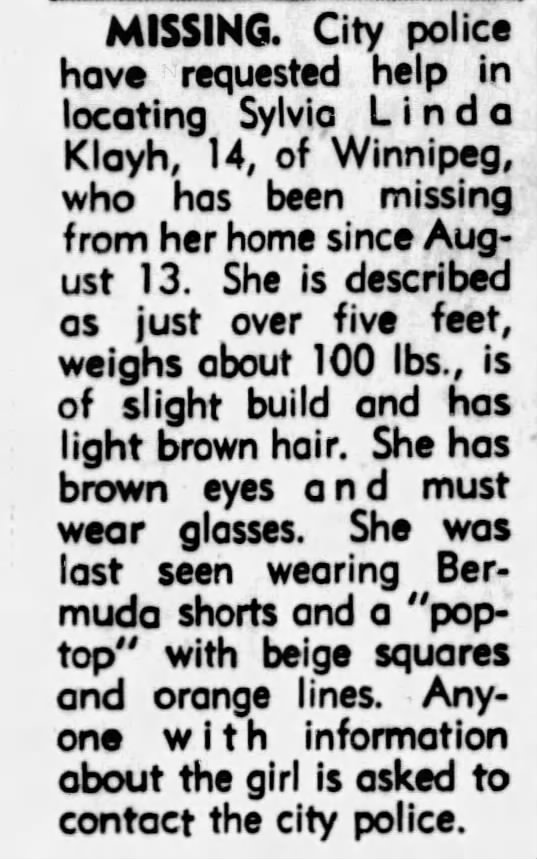
Calgary, Alberta, Canada. Wed, 13 Sept 1967.
Page 26
Sylvia is also officially associated with the alternate name Sylvia Linda Ciprianovich. The RCMP lists Ciprianovich as an alias, although publicly available information does not explain why that surname was connected to her. Without documentation establishing its origin, it would be inappropriate to speculate about whether it came from another branch of her family or some other circumstance.
Several possibilities therefore remain. Sylvia may have entered the wilderness surrounding Brereton Lake and suffered an accident. She may have deliberately left the area and begun hitchhiking east. She may have been the girl reportedly seen farther into Ontario, although that sighting has never been publicly confirmed. She may also have voluntarily begun her journey only to encounter foul play somewhere along the way.
The possibility that Sylvia successfully disappeared and established another life cannot be completely eliminated either, particularly given how much easier it was to live without leaving a digital trail in 1967. But Sylvia was only 14 years old. Successfully creating an entirely new identity, surviving independently and never making confirmed contact with anyone in her family would have been an extraordinary undertaking. There is no public evidence showing that she ever did so.
What makes Sylvia’s disappearance particularly haunting is how ordinary its beginning appears to have been. There was no mysterious nighttime disappearance, abandoned vehicle or obvious sign of violence. A father and his teenage daughter argued at a cottage. Sylvia walked away at approximately eleven o’clock on a summer morning, apparently without telling anyone where she was going. Her family likely expected her to return once she had cooled down.
She never did.
Nearly six decades later, there is still no verified public sighting of Sylvia after she left the cottage at Brereton Lake on August 13, 1967. The Ottawa possibility, the Wawa lead and the suggestion that she may have been travelling through Ontario offer tantalizing possibilities, but none has been proven to represent Sylvia’s actual movements.
Somewhere after Sylvia stepped away from that cottage, the trail simply ends. Whether she disappeared in the Manitoba wilderness, reached the highway and accepted a ride, travelled hundreds of kilometers into Ontario or encountered someone who prevented her from ever coming home remains unknown.
The RCMP continues to acknowledge the possibility of foul play in Sylvia’s disappearance.
What happened to the 14-year-old girl who walked away from Brereton Lake remains one of Manitoba’s longest-standing missing-person mysteries.
If you have information on Sylvia’s case, please contact any of the following:
RCMP D Division Missing & Exploited Persons Unit: 204-983-6055
Reference Case#: 2012256771
Canada’s Missing Case reference: 2012020059
Crime Stoppers: 1-800-222-TIPS(8477)
Online at: https://www.canadiancrimestoppers.org/submit-a-tip/submit-a-tip
Crime Stoppers provides anonymous tipping
Send email to the National Centre for Missing Persons and Unidentified Remains at: canadasmissing-disparuscanada@rcmp-grc.gc.ca
Sources: Canada’s Missing, Historical Manitoba Missing Persons information, The Sault Star archival reporting, Calgary Herald archival reporting, The Doe Network
🕯️ Subscribe to Someone Saw Something. I dig through the details, ask the unanswered questions, and occasionally fall down research rabbit holes so you don’t have to. 🧡

