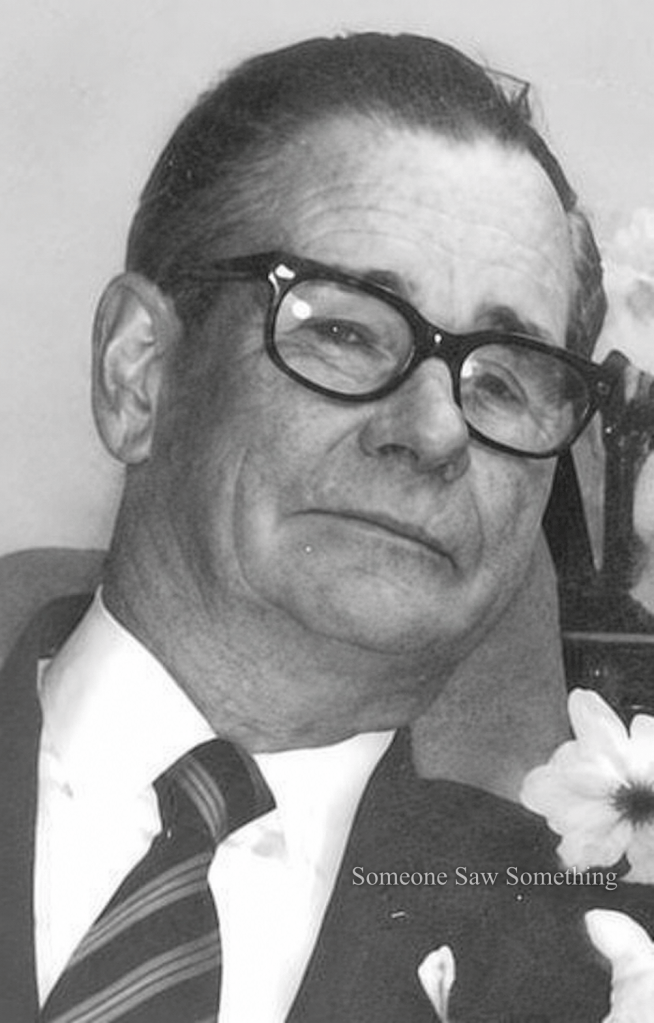
On August 5, 1987, 58-year-old Russell Don Atkinson boarded a Greyhound bus in Penticton, British Columbia, intending to make the long journey east to Winnipeg, Manitoba. Somewhere along the way, however, Russell disappeared. He never arrived at his destination, and nearly four decades later, he has never been seen or heard from. What makes his disappearance even more suspicious is that his luggage was later found aboard the bus without him.
According to the RCMP, Russell was born in 1929 and was approximately five feet eight inches tall and 150 pounds, with a medium build and brown hair. He wore plastic-framed glasses and word dentures / false teeth. Russell was also missing his left eye and had previously broken his left ring finger. When he disappeared, he was wearing a blue Western-style shirt, brown pants, a wool sports jacket and black leather Oxford shoes. He also wore a watch with a green strap.
The last publicly documented sighting of Russell places him boarding the Greyhound in Penticton. After that, his movements become unclear. The RCMP information does not reveal where along the journey he was last seen, where his luggage was eventually discovered or whether anyone remembered seeing him at one of the stops along the way. Those missing details are crucial because a journey from Penticton to Winnipeg would have covered more than two thousand kilometers and would have definitely involved a number of stops and transfers.
Reconstructing Russell’s exact journey is difficult because his original Greyhound itinerary has not been made publicly available. One plausible route would have taken him north through the Okanagan toward Kelowna before turning east through the British Columbia Interior and the Rocky Mountains. From there, an eastbound passenger could continue through Alberta and Saskatchewan before eventually reaching Manitoba. Another route through Osoyoos and the southern Kootenays may also have been possible, although there is no evidence currently available showing which route Russell actually travelled.
There is also an important question about whether Russell was supposed to remain on one bus for most of the journey or make connections along the way. Long-distance Greyhound travel frequently involved transfers, and Russell’s luggage could have been tagged through to Winnipeg even if he had to change coaches. If he failed to make one of those connections, his luggage could conceivably have continued travelling without him.
That creates one of the simplest possible explanations for his disappearance. Russell may have stepped off the bus at a terminal or rest stop to eat, use a washroom or stretch his legs and never returned. He could have misunderstood the departure time, gone to the wrong coach, become ill or experienced some other emergency. If his luggage was stored beneath the bus, the driver might not have immediately realized that Russell had failed to return before departing.
If this happened somewhere in the mountainous interior of British Columbia or Alberta, Russell could have become lost or injured in an area where finding him would have been extremely difficult. If it happened at a major terminal, however, the circumstances could have been completely different. He might have become confused during a transfer, encountered someone outside the station or deliberately changed his plans. Without knowing his last confirmed location after Penticton, there is simply no way to determine which scenario is more likely.
There has been no publicly released evidence establishing that Russell was the victim of foul play. Nevertheless, it cannot be completely excluded. If Russell stepped away from a terminal and encountered someone, investigators would first have needed to know where he left the bus before they could even determine where to concentrate their investigation.
Another possibility is that Russell eventually became an unidentified deceased person. Because he could potentially have disappeared anywhere between British Columbia and Manitoba, unidentified remains cases across several provinces could warrant consideration. In searching the publicly available records do not reveal an obvious match, but that does not necessarily mean every unidentified person has been compared with Russell.
His specific physical characteristics could be valuable in such an investigation. Depending on how he actually lost his left eye, there could potentially have been physical evidence useful to forensic specialists. His previously broken left ring finger might also have left identifiable evidence in the bone, while his dentures could provide another clue if corresponding records existed.
Still, the most important clue in Russell’s disappearance is not something Russell carried with him, but what he left behind. His luggage somehow remained within the Greyhound system after Russell himself was gone. Someone eventually had to notice that those belongings belonged to a passenger who was no longer there.
Exactly where that happened could also change our understanding of the case. If Russell’s suitcase reached Winnipeg before anyone realized he was missing, he could possibly have left the bus almost anywhere along the enormous journey from Penticton. If the luggage was discovered much earlier, however, investigators might be able to narrow his disappearance to a considerably smaller area.
The contents of Russell’s luggage could also be revealing. If his identification, money, medication or other essential possessions were inside, deliberately abandoning the suitcase would be difficult to explain. If he kept those items on his person, voluntarily leaving the journey becomes somewhat more plausible. Unfortunately, the publicly available information does not reveal what investigators found inside his luggage.
The baggage tag itself could be even more valuable. It might identify Russell’s destination, transfer points or the buses that handled his suitcase. Greyhound records from August 1987, including timetables, driver logs, baggage reports or employee statements, could potentially establish where Russell was last known to be aboard the bus. Whether those records still exist is unknown. Investigators in 1987 were also working without many of the tools that would make reconstructing such a disappearance easier today. There were no cell-phone location records or electronic boarding passes following Russell from terminal to terminal, and surveillance cameras were far less common. If Russell stepped away from a bus station or roadside stop, he could have left remarkably little evidence behind.
There must have been witnesses who remembered seeing or interacting with him. A passenger could have noticed Russell getting off at a particular stop, while a driver or terminal employee might have spoken with him. Police may even have collected those statements during the original investigation, but if they did, the details have never been included in the public case summary.
This is why Russell’s original police and Greyhound records could still be extraordinarily important. His ticket could reveal exactly where he was supposed to transfer. His baggage tag could show how his suitcase travelled. An employee report might identify where the luggage was discovered, and an old witness statement could reveal the last place Russell was actually seen after leaving Penticton.
Russell’s case ultimately revolves around a very small missing piece in an otherwise clearly defined journey. We know where he started, and we know where he intended to go. On August 5, 1987, Russell Don Atkinson boarded a Greyhound bus in Penticton expecting, as far as anyone knows, to eventually arrive in Winnipeg. His luggage continued travelling without him, but somewhere along that journey Russell vanished.
Whether he ended up being separated from the bus during an ordinary rest stop, missed a connection, suffered an accident or medical emergency, deliberately changed his plans or encountered foul play remains unknown. Somewhere between Penticton and Winnipeg is the place where Russell’s journey actually ended, and determining where his unattended luggage was first discovered may still be one of the best clues to finding out what happened to Russell Don Atkinson.
If you have information on Russell’s case, please contact any of the following:
Penticton RCMP: 250-492-4300
Reference Case#: 87-10365
Canada’s Missing Case Reference: 2014001731
Crime Stoppers: 1-800-222-TIPS(8477)
Online at: https://www.canadiancrimestoppers.org/submit-a-tip/submit-a-tip
Crime Stoppers provides anonymous tipping
Send email to the National Centre for Missing Persons and Unidentified Remains at: canadasmissing-disparuscanada@rcmp-grc.gc.ca
Sources: Canada’s Missing, Greyhound, Youtube, Canada Unsolved
🕯️ Subscribe to Someone Saw Something. I dig through the details, ask the unanswered questions, and occasionally fall down research rabbit holes so you don’t have to. 🧡
 Someone Saw Something